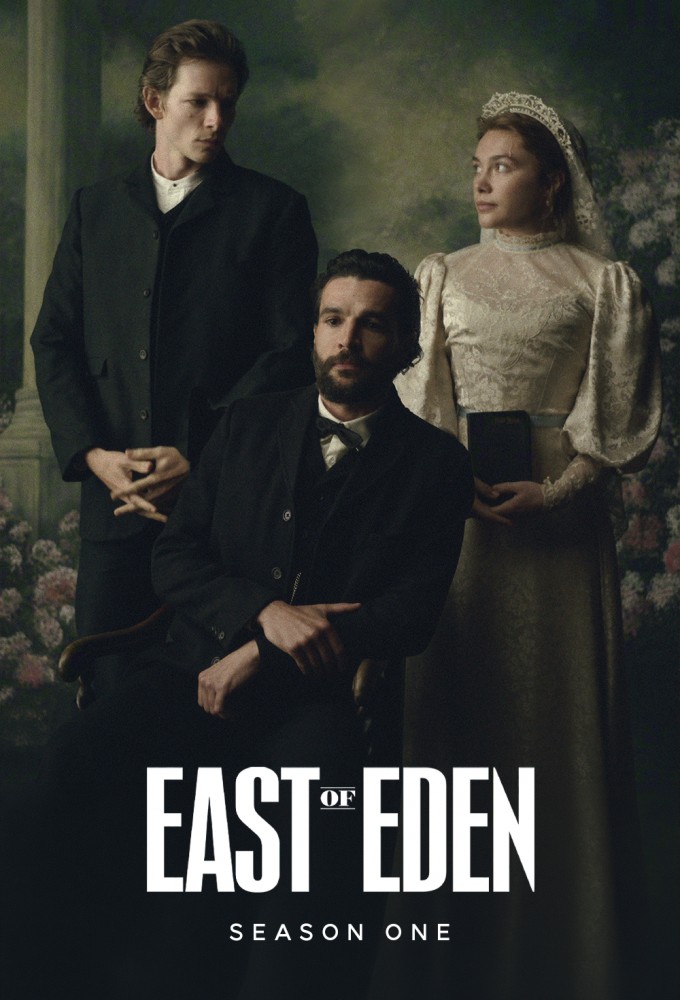

Why Watch
"Experience John Steinbeck's epic generational tragedy reimagined with fierce modern intensity, stellar performances, and haunting family drama."
Tone: Epic, Tragic, Historical Drama
Streaming Ranks:



AI Critic Analysis
Series Deep Dive:
This lavish limited adaptation of East of Eden resurrects John Steinbeck's classic tale with astonishing vigor. Zoe Kazan pens an unflinching exploration of generational trauma, betrayal, and free will across California's Salinas Valley. Anchored by commanding lead performances, the completed limited series offers a definitive literary prestige piece. It examines the perpetual clash between virtue and vice, honoring its source material while delivering devastating emotional payoff from start to finish.
Analysis Refined:September 2026
Scheduled next refinement: in 529 days
Season: 1
| Watched? | # | Air Date | Episode Name |
|---|---|---|---|
| E1 | Oct 01, 2026 | Brothers | |
| E2 | Oct 01, 2026 | Cathy | |
| E3 | Oct 01, 2026 | In the Valley | |
| E4 | Oct 01, 2026 | Kate | |
| E5 | Oct 01, 2026 | Departure | |
| E6 | Oct 01, 2026 | The Great Try | |
| E7 | Oct 01, 2026 | Timshel |
Production Note - Limited Series
Production Type: Historical Drama Miniseries
East of Eden (2026) is a standalone Historical Drama Miniseries designed as a finite narrative. The seven-part adaptation brings John Steinbeck’s classic multigenerational saga to television with a complete, closed arc. Creator Zoe Kazan reinterprets the literary masterpiece by focusing squarely on Cathy Ames alongside the Trask family dynamics, resolving the central conflicts of moral division and lineage. Conceived strictly as an expansive limited event rather than an open-ended serial, the production fully exhausts its source material across its definitive run.
Production Trivia: Adapted from John Steinbeck's 1952 epic novel, the seven-episode series was created and written by Zoe Kazan, whose grandfather Elia Kazan directed the famous 1955 film adaptation.
Oracle Insights Refined:September 2026
Scheduled next refinement: in 486 days
If you liked East of Eden (2026):





Trailer
Technical Details
- Network: Netflix
- Seasons: 1
- Years: 2026 - 2026
- Genre: Drama, Mini-Series, Romance
- Rating: TV-MA
Frequently Asked Questions
The production is designed as a limited series, meaning it is intended to tell a complete story within a single season. As a definitive adaptation of a specific novel, there are currently no plans for a second season or a continuation beyond the initial run.
The series is a television adaptation of the classic 1952 novel written by John Steinbeck. While the book draws on some of Steinbeck's own family history and biblical allegories, it is primarily a work of fiction rather than a strictly true story.
The production primarily filmed on location in New Zealand to recreate the sprawling landscapes required for the story. Specific filming locations were chosen to mirror the Salinas Valley setting described in the original source material.
The limited series consists of seven episodes in total. This format was chosen to provide enough time to explore the complex intergenerational themes and character arcs found in the original novel.
The series features Florence Pugh in the lead role of Cathy Ames, alongside actors like Christopher Abbott and Mike Faist. The production is written and executive produced by Zoe Kazan, whose grandfather directed the famous 1955 film adaptation.
The series follows the interconnected lives of two families, the Trasks and the Hamiltons, living in California's Salinas Valley. It explores deep themes of identity, guilt, and the struggle between good and evil across multiple generations.
FAQ Refined:September 2026
Scheduled next refinement: in 357 days