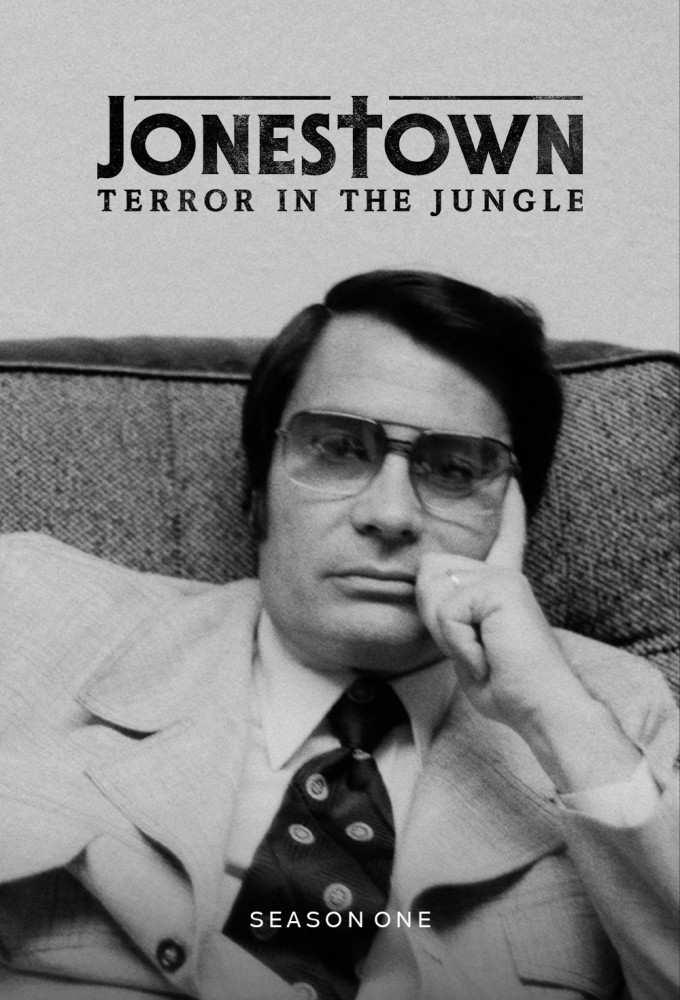

Why Watch
"Uncover the chilling psychological descent of Jim Jones's cult through harrowing archival audio and firsthand survivor accounts."
Where to Watch












 Streaming details by:
JustWatch
Streaming details by:
JustWatch
AI Critic Analysis
Series Deep Dive:
Executive produced by Leonardo DiCaprio, Jonestown: Terror in the Jungle delivers a definitive post-mortem on the Peoples Temple tragedy. Airing on SundanceTV, this four-part docuseries contextualizes Jim Jones's manipulative rise from progressive social crusader to paranoid mass murderer. Through previously unreleased FBI recordings and poignant survivor reflections, the production moves beyond sensationalism, constructing an authoritative, emotionally devastating portrait of blind faith, institutional failure, and absolute psychological manipulation.
Season: 1
| Watched? | # | Air Date | Episode Name |
|---|---|---|---|
| E1 | Nov 17, 2018 | Making of a Madman | |
| E2 | Nov 17, 2018 | On The Run | |
| E3 | Nov 18, 2018 | Under Siege | |
| E4 | Nov 18, 2018 | Death In The Promised Land |
Production Note - Limited Series
Production Type: Miniseries
Jonestown: Terror in the Jungle is a standalone Miniseries designed as a completed, finite historical narrative. Produced for the 40th anniversary of the Jonestown massacre, the production utilizes archival footage, declassified FBI documents, and survivor interviews to provide a comprehensive account of Jim Jones and the Peoples Temple. The series was structured specifically to trace the movement from its inception in Indianapolis to its tragic conclusion in Guyana, ensuring a closed-ended viewing experience.
The project was developed as a definitive documentary event rather than an ongoing series, focusing on a singular historical tragedy with a clear chronological endpoint. By centering the narrative on the specific events leading up to November 18, 1978, the creators fulfilled their objective of documenting the rise and fall of the cult within a four-hour framework. This finite approach allowed the production to serve as a complete historical record, leaving no narrative threads for future installments.
If you liked Jonestown: Terror in the Jungle:





Technical Details
- Network: SundanceTV
- Seasons: 1
- Years: 2018 - 2018
- Genre: Crime, Documentary, Drama, History, Mini-Series