
Why Watch
"Relive the definitive eighties action classic featuring David Hasselhoff and his high-tech, crime-fighting Pontiac Firebird."







AI Critic Analysis
Series Deep Dive:
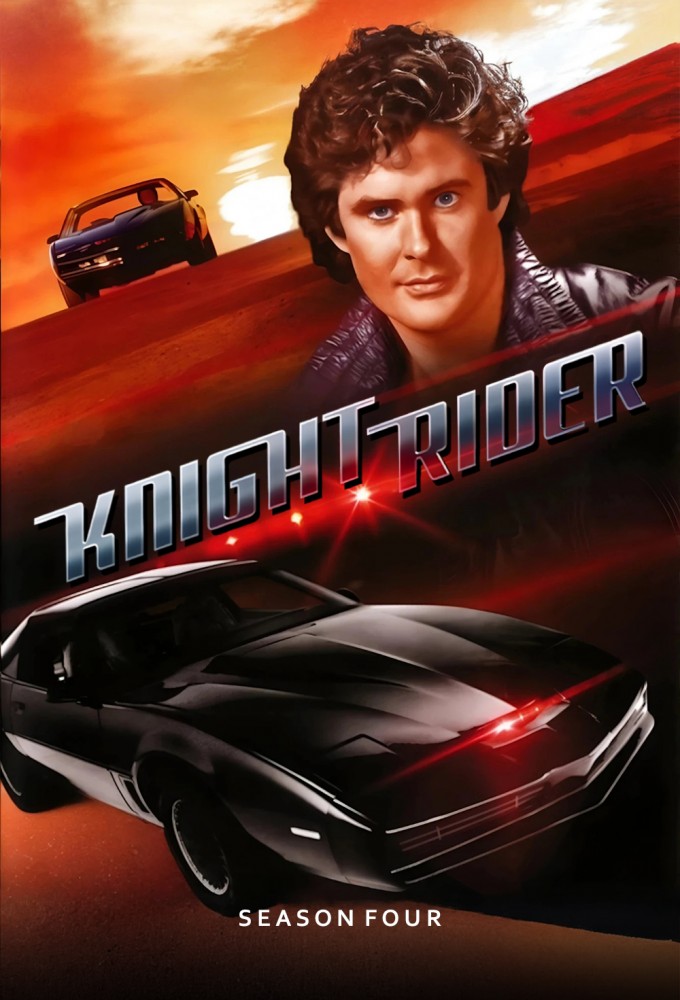
David Hasselhoff cemented his pop-culture legacy as Michael Knight in Knight Rider, NBC's defining eighties action serial. Paired with K.I.T.T., an advanced artificial intelligence housed inside an invulnerable Pontiac Trans Am, Knight navigated a high-speed crusade for justice. The fourth and final season elevated the spectacle with new vehicle modes and daring stunts, delivering a nostalgic, fun blast of vintage television that remains an enduring touchstone of retro adventure.
Season: 4
| Watched? | # | Air Date | Episode Name |
|---|---|---|---|
| E1 | Sep 20, 1985 | Knight of the Juggernaut (1) | |
| E2 | Sep 20, 1985 | Knight of the Juggernaut (2) | |
| E3 | Sep 27, 1985 | KITTnap | |
| E4 | Oct 18, 1985 | Sky Knight | |
| E5 | Oct 25, 1985 | Burial Ground | |
| E6 | Nov 01, 1985 | The Wrong Crowd | |
| E7 | Nov 08, 1985 | Knight Sting | |
| E8 | Nov 15, 1985 | Many Happy Returns | |
| E9 | Nov 29, 1985 | Knight Racer | |
| E10 | Dec 06, 1985 | Knight Behind Bars | |
| E11 | Dec 13, 1985 | Knight Song | |
| E12 | Jan 03, 1986 | The Scent of Roses | |
| E13 | Jan 10, 1986 | Killer K.I.T.T. | |
| E14 | Jan 17, 1986 | Out of the Woods | |
| E15 | Jan 24, 1986 | Deadly Knightshade | |
| E16 | Jan 31, 1986 | Redemption of a Champion | |
| E17 | Feb 07, 1986 | Knight of a Thousand Devils | |
| E18 | Feb 14, 1986 | Hills of Fire | |
| E19 | Feb 21, 1986 | Knight Flight to Freedom | |
| E20 | Mar 07, 1986 | Fright Knight | |
| E21 | Mar 14, 1986 | Knight of the Rising Sun | |
| E22 | Apr 04, 1986 | Voo Doo Knight |
Series Legacy & Historical Archive
Franchise Status: Legacy / Dormant
Knight Rider remains a definitive pillar of action-adventure television, having concluded its influential run on NBC. Beyond its high-octane stunts and the iconic red scanner light of the KITT 2000, the series pioneered the concept of a sentient technological partner long before AI became a household reality. The chemistry between Michael Knight and his dry-witted Trans Am transformed a standard procedural into a futuristic buddy-cop dynamic that resonated with a generation dreaming of the digital age. It established a blueprint for the lone hero archetype supported by cutting-edge gadgetry, a formula that would be replicated across countless television franchises and films in the decades that followed.
The show survives as a rewatch staple primarily due to its pure escapist charm and the sincerity of its central message that one man can make a difference. While the visual effects and synth-heavy score are distinctly rooted in the eighties, the underlying themes of justice and the bond between man and machine possess a timeless quality. Fans return to the series not just for the nostalgia of the Turbo Boost but for the optimistic vision of technology serving as a force for good. Its legacy is preserved through a dedicated global fanbase and its status as a foundational text in the evolution of science fiction on the small screen.
If you liked Knight Rider:





Trailer
Technical Details
- Network: NBC
- Seasons: 4
- Years: 1982 - 1986
- Genre: Action, Crime, Drama, Science Fiction
- Rating: TV-PG