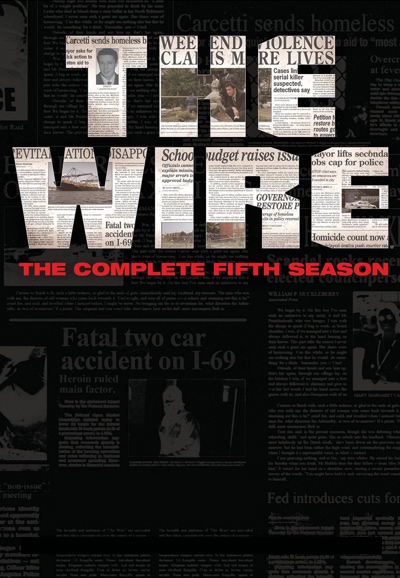

Why Watch
"David Simon's landmark drama delivers an unsparing, systemic autopsy of American urban decline with unparalleled realism and narrative precision."
Tone: Cerebral, Gritty Crime Procedural
Streaming Ranks:







AI Critic Analysis
Series Deep Dive:
Widely regarded as television's definitive institutional critique, The Wire deconstructs the interconnected decay of Baltimore across five distinct vantage points. From narcotics enforcement and maritime labor to politics, education, and print journalism, creator David Simon and producer Ed Burns reject sensationalism. The series crafts an intricate, morally complex study of bureaucracy, poverty, and systemic compromise where individual reform is relentlessly ground down by the institutions built to sustain it.
Analysis Refined:March 2026
Scheduled next refinement: in 417 days
Season: 5
| Watched? | # | Air Date | Episode Name |
|---|---|---|---|
| E1 | Jan 06, 2008 | More With Less | |
| E2 | Jan 13, 2008 | Unconfirmed Reports | |
| E3 | Jan 20, 2008 | Not for Attribution | |
| E4 | Jan 27, 2008 | Transitions | |
| E5 | Feb 03, 2008 | React Quotes | |
| E6 | Feb 10, 2008 | The Dickensian Aspect | |
| E7 | Feb 17, 2008 | Took | |
| E8 | Feb 24, 2008 | Clarifications | |
| E9 | Mar 02, 2008 | Late Editions | |
| E10 | Mar 09, 2008 | -30- |
Series Legacy & Historical Archive
Franchise Status: Concluded Historical Archive
The Wire remains a definitive pillar of television, having concluded its influential run on HBO. David Simon’s sprawling masterpiece revolutionized episodic drama by treating Baltimore as an intricate, tragic living organism rather than a mere backdrop. By dissecting the interconnected failures of law enforcement, politics, education, and the press, the narrative achieved unprecedented literary depth. The Wire eschewed conventional melodrama for rigorous sociological critique, ultimately establishing an enduring artistic benchmark that continues to define the apex of serial storytelling across modern television.
Oracle Insights Refined:March 2026
Scheduled next refinement: in 414 days
If you liked The Wire:





Technical Details
- Network: HBO
- Seasons: 5
- Years: 2002 - 2008
- Genre: Crime, Drama, Thriller
- Rating: TV-MA
Frequently Asked Questions
The Wire consists of five total seasons that aired on HBO between 2002 and 2008. Each season explores a different facet of Baltimore, including the drug trade, the seaport, the city government, the school system, and the print news media.
Creator David Simon decided to conclude the series because he felt the narrative arc regarding the systemic failures of Baltimore was complete. Although the show suffered from low ratings during its initial run, HBO allowed the creators to finish the story according to their original vision.
There are no full-length spin-off series, but three short prequel films were produced to provide additional backstory for characters like Prop Joe and Omar Little. A proposed spin-off titled The Hall, which was meant to focus on the city's political landscape, never moved past the development stage.
There are currently no credible rumors or official plans to reboot or revive the series. David Simon has consistently stated that he would only consider returning to that world if the United States government fundamentally changed its policies regarding the war on drugs.
We Own This City is considered a spiritual successor rather than a direct sequel, as it features different characters and is based on a non-fiction book. While it shares the same creator and Baltimore setting, it focuses on the real-life corruption within the Baltimore Police Department's Gun Trace Task Force.
The show was never technically canceled, though it faced the threat of cancellation multiple times due to its low viewership numbers. The creators had to lobby HBO executives for each renewal until they were finally granted the fifth and final season to wrap up the narrative.
FAQ Refined:March 2026
Scheduled next refinement: in 167 days